)
)
Connecting the dots in flooring circularity
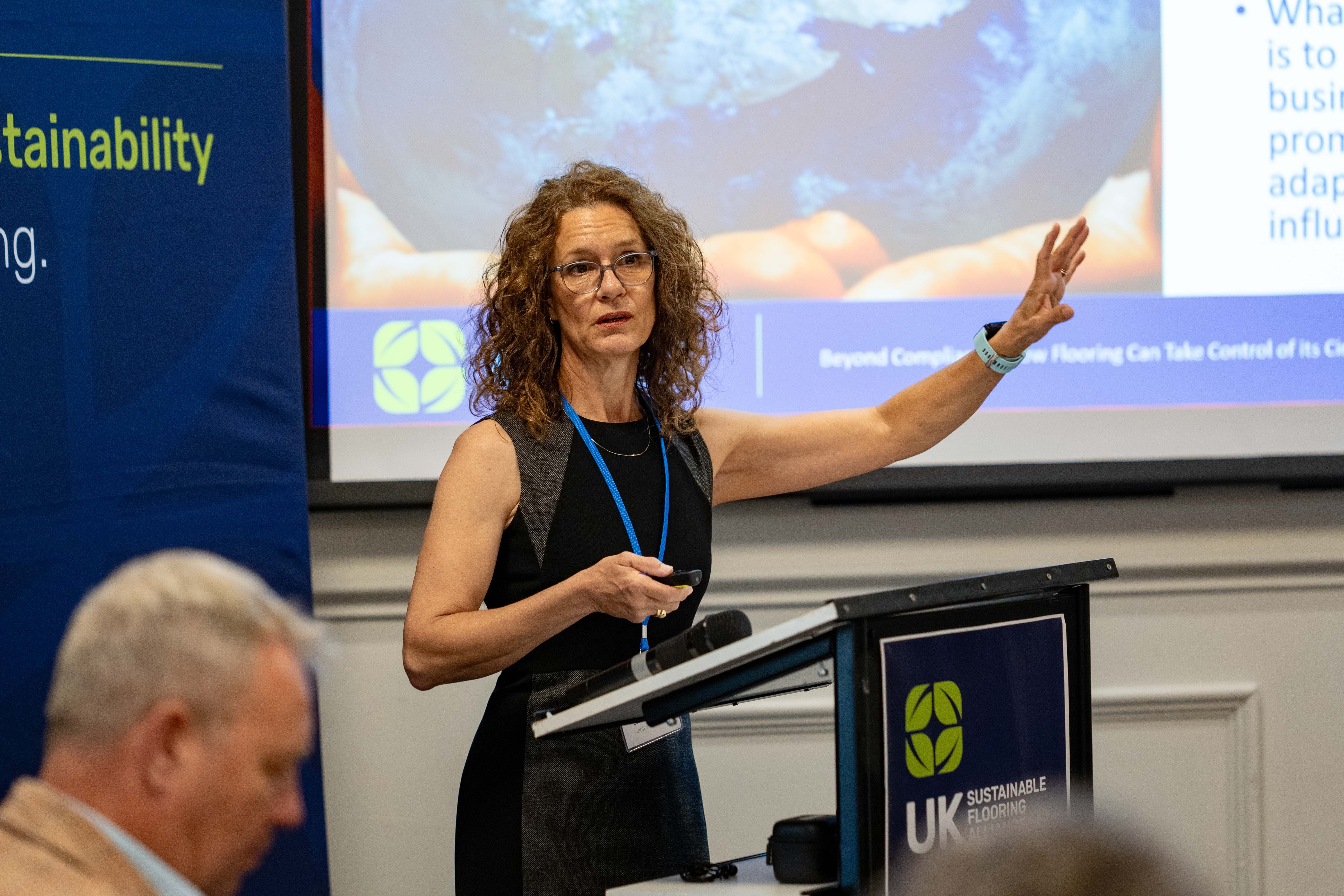
By Cathie Clarke, CEO, The UK Sustainable Flooring Alliance (UKSFA)
Across the built environment, businesses are facing tougher questions about waste, resources, product information, recycling and what happens to materials at the end of their useful life.
The role of the UKSFA is to bring together policymakers and companies from across the flooring supply chain, to help the industry understand what needs to change, why, and importantly, how we can make that change work in practice.
We all know change can be difficult, and businesses are operating in an increasingly challenging economic environment. Nobody wants unnecessary cost, complexity or bureaucracy. The sustainability conversation must move beyond simply telling businesses what they ‘should’ be doing. We need to work together to develop practical systems that can ultimately save resources and money, while reducing waste.
Where there’s challenge, there’s opportunity
UKSFA estimates that more than 800,000 tonnes of carpet, vinyl, LVT and other flooring materials are removed or replaced across the UK every year; that’s the equivalent to more than 18,000 articulated lorries. Much of this material currently ends up being incinerated or sent to landfill, with around 5 per cent recovered through reuse or recycling.
In 2025, the UKSFA commissioned Resource Futures to examine the current landscape of flooring take-back schemes and recycling infrastructure across the UK. The research looked at how flooring is collected, managed and processed, and where the opportunities and barriers to greater recovery lie.
One of the clearest messages in the research was we need better collaboration and better data across the flooring value chain, which sounds straightforward, but putting this into practice is far less so.
But this doesn’t just apply to flooring. Across the construction industry, we need to understand what materials are coming out of buildings, where they are going, how they are being collected, what can be reused or recycled and where the infrastructure exists to process them.
We also need practical systems that businesses can use, and we are already seeing a rise in the number of new digital businesses coming on to the market to support product reuse and facilities management. In flooring, the UKSFA for example is working on issues such as take-back, reuse and recycling, while engaging with policymakers to ensure they are able to consider this work as they develop future policy.
It is also important to connect the right materials with the right destinations. TakeMyFlooring (TMF), for example, can help send materials to schemes that want to receive specific types of flooring, supporting greater reuse and helping to address some of the practical challenges around finding appropriate end destinations.
Preparing for what is coming
Governments in the EU and USA are increasingly using Extended Producer Responsibility (EPR) to change how businesses manage products and materials at end of life. Packaging EPR is already in operation in the UK, with similar producer-responsibility rules applying to electrical equipment and batteries.
An EPR for flooring has been mooted by the Government since 2018, and ‘Buildings & Furniture’ is one of Defra’s Circular Economy Task Force priority areas. Although an EPR for flooring is not yet in place, it remains on the agenda. The industry therefore has an opportunity to develop an ‘oven ready’ model that reflects the realities of flooring, from manufacture and installation through to removal, reuse, recycling and end of life.
Work is already underway to consider what a potential EPR scheme could look like. Developing a scheme by industry, for industry could help ensure it is practical, cost-effective and supports waste management within the flooring sector.
The scale of the challenge is significant and getting the process right will take time, but we need to start now. If the French EPR system were applied to the UK, it is estimated this could cost the flooring industry a minimum of £62 million a year.
The same principle applies to product identification and information. Better product information is vital for more effective and cost-efficient waste management and take-back schemes. As requirements around product information and sustainability develop, we need systems that make it easier to identify products and understand what can happen to them at the end of their life.
From greenwashing to better information
There is another important connection in circularity, which includes sustainability claims and consumer information.
Businesses are increasingly expected to demonstrate the environmental credentials of their products. At the same time, there is growing scrutiny of greenwashing and the accuracy of environmental claims. That means we need to make it easier for businesses and consumers to understand what claims actually mean.
Sustainability should not become a competition in who can make the biggest environmental claim, but rather, ensure accurate information is available so they can make better-informed decisions. The EU has introduced the EmpCo Directive which has been brought in to provide consumers with more power on sustainability claims. Although initially focused on high use items such as clothing and tech, the direction of travel is clear.
Reuse and connecting the dots of sustainability
The transition to a more circular built environment will take time. The question is whether we spend that time reacting to change, or preparing, collaborating and helping shape what comes next, connecting ideas to action and policy to practical solutions.
Reuse sits at the top of the waste hierarchy and, while we move forward on Takeback and EPR, it offers an opportunity for more immediate progress through collaboration.
Flooring poverty is estimated to affect 1.5 million UK homes. At the same time, significant volumes of ‘new’ flooring, which can include end-of-lines, B-grade and surplus material bought ‘just in case’, are sent to landfill or incineration when they could be diverted to those in need, without disrupting existing markets.
Weekly furniture and flooring loan schemes may provide a short-term solution, but risk perpetuating the cycle of poverty. Social housing policy could also move back towards a ‘check and clean’ approach rather than routinely stripping out flooring.
We have an opportunity to take control of the challenges ahead, rather than waiting for them to take control of us. That is how we move from sustainability ambition to a system that actually works.