)
)
Why Nature Recovery Needs Urban Climate Risk Thinking
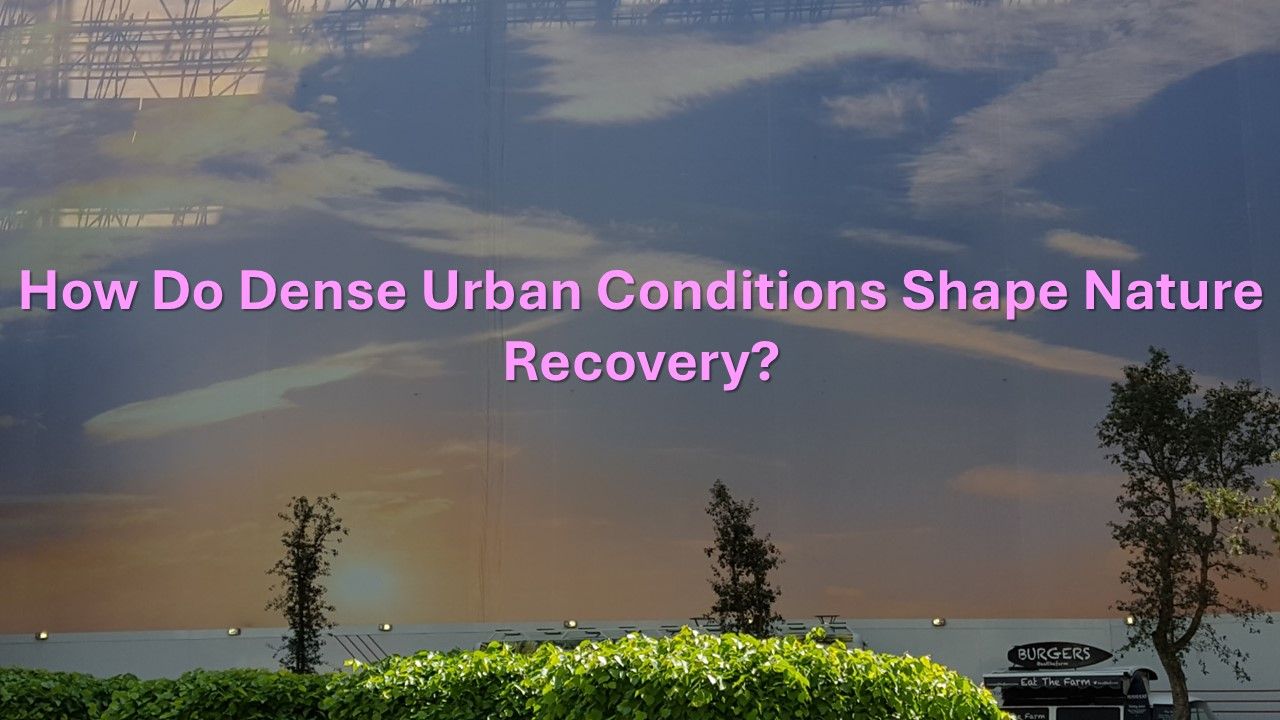
Trees and green infrastructure are now central to the urban resilience discourse. They are increasingly called upon to cool streets, provide shade, support biodiversity, improve water management, and contribute to healthier everyday environments. As these expectations grow, vegetation is increasingly treated not simply as an ecological asset or ornamental addition, but as a component of climate adaptation infrastructure. That shift, however, raises a more fundamental question. If trees and green infrastructure are expected to perform as climate infrastructure, what conditions are required for that performance to be sustained over time?
The next step in urban nature recovery is therefore not simply to increase provision through more trees, more planting, more canopy, more greening, or more nature-based solutions. Long-term benefit depends on more than presence alone. The familiar principle of right tree, right place still matters, as do species choice, local context, and long-term stewardship. But these alone do not fully address the abiotic (non-living) conditions that shape biotic health, ecological resilience, and long-term performance.
Urban nature recovery must therefore be understood in terms of environmental viability as well as provision. The key question is not only what is planted, or how much, but whether urban environments can sustain vegetation that is able to establish, recover from stress, and continue to function effectively over time. What matters, in other words, is whether the climatic and abiotic conditions produced by the urban environment are sufficient to support long-term ecological performance.
For vegetation to deliver long-term benefit, it must be able to function over time. Trees and planted systems do not generate benefit simply by being present. Their contribution depends on whether they can establish, remain viable, recover from stress, and continue to function as conditions change. That support depends on more than soil volume, rooting conditions, drainage, and irrigation, important though those are. It also depends on the character of the above-ground environment: solar access, airflow, thermal exposure, moisture conditions, water movement, and the capacity for recovery after periods of stress. These are not secondary technical details. They shape whether vegetation can survive, whether it can grow well enough to deliver meaningful benefit, and whether that benefit can be sustained.
A tree may not fail immediately, yet still experience slow, cumulative stress that weakens long-term performance. A planting strategy may appear sound on paper yet still falter if surrounding urban conditions repeatedly generate stress beyond the capacity of vegetation to cope or recover. The issue is therefore not simply horticultural. It is also spatial, climatic, and developmental. What matters is not only whether vegetation is specified, but whether the environments into which it is introduced are capable of supporting biotic performance over time.
This is where architecture and urban form become critical. Buildings, streets, surfaces, enclosure, orientation, density, and spatial arrangement do not merely provide the setting for vegetation. They help produce the climatic conditions within which vegetation must function. Through their effects on solar access, shading, airflow, heat storage, exposure, shelter, and moisture, they shape the abiotic environment experienced at street level and across urban space. In that respect, architecture is not simply adjacent to nature recovery. It is integral to the environmental conditions that determine whether nature-based strategies are able to succeed.
What matters here is not only that urban form influences climate, but that it shapes climatic conditions spatially and temporally. The performance of vegetation depends not on average
conditions in the abstract, but on the actual patterns of exposure, shelter, stress, and recovery that occur in particular places and at particular times. Background climate matters, but so too does the way urban form redistributes that climate through layout, enclosure, orientation, built density, hard surface cover, and building geometry. Together these shape where heat accumulates, where air moves or stagnates, where surfaces remain exposed, where moisture is retained or lost, and whether planted systems are able to recover after periods of environmental stress.
This has important consequences for how greening strategies are conceived and assessed. A development may perform well against canopy or planting metrics while still generating local climatic conditions that constrain long-term biotic performance. Equally, well-considered urban form may improve the conditions under which vegetation can thrive and continue to deliver benefit over time. Quantity matters, but it is not the same as viability. The question is therefore not simply whether vegetation can be inserted into urban space, but whether the conditions of that space are capable of sustaining ecological performance.
What is needed, then, is a more explicit urban climate risk perspective on nature recovery. Such an approach would ask not only how much vegetation is to be provided, but what abiotic conditions urban form is likely to produce, how those conditions are distributed across space and time, and whether they are capable of supporting long-term biotic health and function. Nature recovery, in this sense, is not simply a matter of provision. It is a matter of shaping urban environments that can sustain life well enough for ecological and climatic benefit to endure.
For practice, the implication is clear. Urban greening should not be treated simply as a layer added after the main spatial decisions have been made. It needs to be considered alongside the climatic consequences of land use, density, layout, enclosure, orientation, hard surface cover, and building form. If biotic systems are to function as climate infrastructure, then architecture and urban form must also be recognised as critical urban climate infrastructure, because they shape the abiotic conditions on which long-term ecological performance depends. The success of nature-based strategies should therefore not be judged through quantity alone, but through viability, recovery, timing, function, and long-term performance under real site conditions.
This is not a call to reduce ambition. On the contrary, it is a way of making ambition more robust. A more climate-aware and architecturally informed approach to nature recovery would strengthen the long-term performance of urban greening, improve the reliability of nature-based adaptation, and help ensure that ecological and climatic benefits endure rather than diminish over time. It would move the discussion beyond provision alone and towards a fuller understanding of how urban environments are shaped, and of the role architecture plays in creating the conditions within which nature must survive.
The next step in urban nature recovery, then, is not simply to fit more vegetation into cities, but to understand more clearly the conditions under which it can succeed. Nature recovery depends not only on what is planted, but on the climatic and abiotic conditions produced by the city itself. In that respect, architecture is not merely a background to ecological performance. It is one of the critical means through which the spatial and temporal conditions of urban climate are structured, and through which long-term nature-based adaptation is either enabled or constrained.
Questions such as these will be central to the new RIBA London Climate SIG, launching soon, which will explore architecture not as backdrop, but as part of the climate infrastructure through which urban environmental conditions are shaped.
Dr Julie Futcher ARB RIBA MintP, Urban Generation | Independent Urban Climate Consultant
Please note:
There will be a TDAG curated seminar on 14th May from 13.30-14.15 on the Placemaking stage about integrating trees and buildings chaired by Richard Smith, Head of Standards, Innovation and Research at the NHBC with Julie Futcher and Gary Winn, architect, building engineer and arboriculturist.
Julie and Will Sandy are running an urban climate walk/Masterclass on 18th June Details here: https://www.eventbrite.com/e/urban-climate-resilience-half-day-master-class-in-the-city-of-london-tickets-1987822200713?aff=oddtdtcreator