)
)
Retrofitting Nature - Why Biophilic Design must become our First Response to Extreme Heat
By Dr Vanessa Champion, Founder & Editor, Journal of Biophilic Design
No one can deny that climate change is an immediate urban and infrastructure design challenge. For all of us working across construction, architecture and the built environment, we need to address how quickly we can transform the places where we already live, work and heal.
“The answer is retrofitting nature across urban and national design as well as internally within and “on” buildings.”
The record-breaking heatwaves we are witnessing across Europe and around the world are no longer extraordinary events, they are becoming our new normal.
Cities are overheating, hospitals are seeing rising admissions during prolonged periods of heat, schools struggle to keep classrooms comfortable enough for learning, office workers experience falling productivity and infrastructure begins to fail as roads soften, rail lines buckle and energy demand surges under the strain of air conditioning.
1. The buildings already exist
One of the greatest challenges facing the construction industry is that most of our future building stock has already been built. Across the UK, millions of homes, offices, schools and public buildings were never designed for the temperatures we are now experiencing.
Retrofitting has become one of the defining challenges of this generation.
Many retrofit conversations focus almost exclusively on insulation, heat pumps and operational carbon. Of course, these are essential interventions, but they represent only part of the solution.
“If we are serious about creating climate-resilient communities, nature must become part of every retrofit strategy. Biophilic Design provides an evidence-based framework for doing exactly that.”
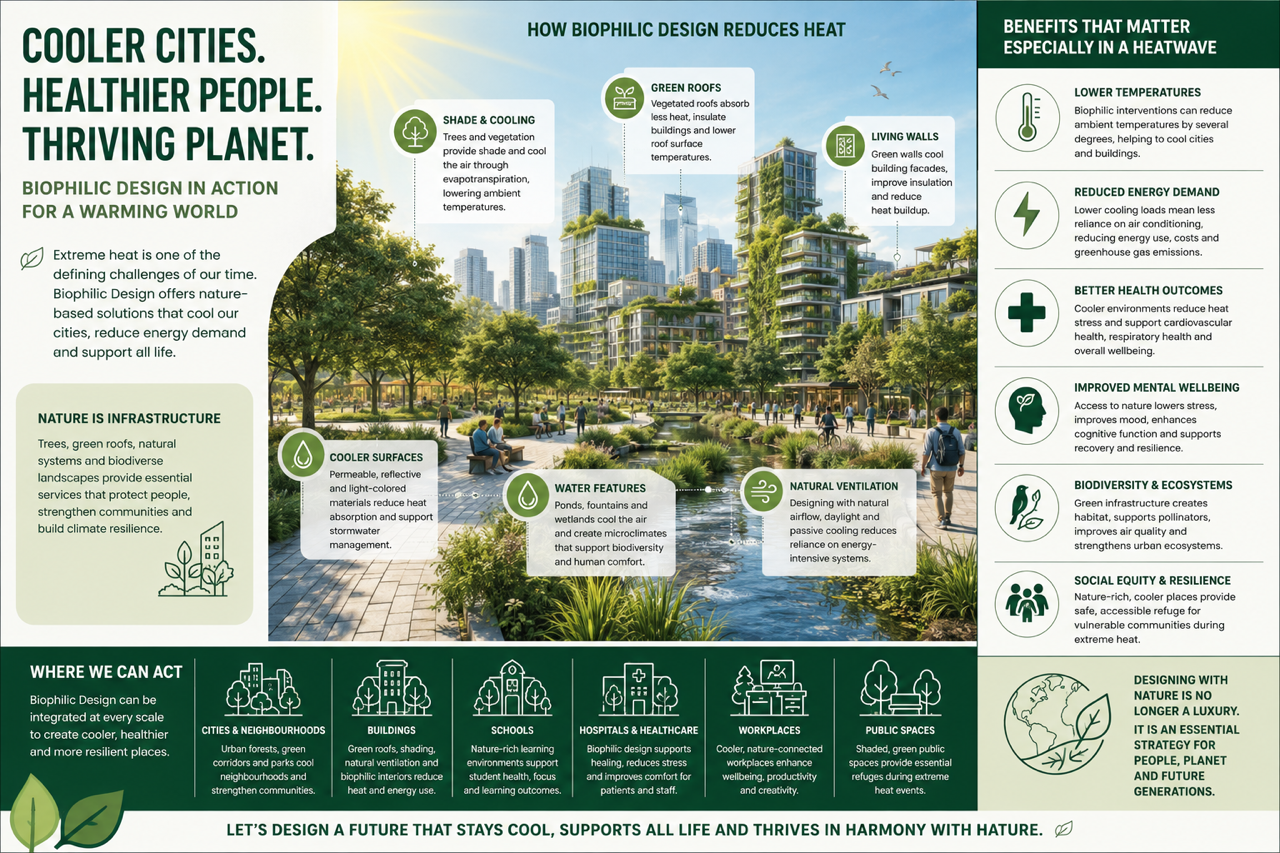
Biophilic Design treats natural systems as essential infrastructure—working alongside engineering solutions to cool buildings, improve health, reduce energy demand and increase resilience. Think: natural ventilation, green walls, less petrochemical materials more natural materials which breathe within our buildings, planting, prospect and refuge spaces for respite and cooling down, punctuated window shading which creates fractal patterns on the floors near windows, water features and raingardens for cooling and creating havens for people in the heat and capturing storm water during heavy rain.
2. Cooling cities naturally
Many of our towns and cities suffer from the Urban Heat Island effect.
Concrete, brick, asphalt and dark roofing absorb solar radiation throughout the day before slowly releasing it overnight, meaning cities often remain significantly warmer than surrounding countryside. This creates a cycle where cooling systems work harder, energy demand increases, and outdoor spaces become increasingly uncomfortable.
“Fortunately, nature has been solving this problem for millions of years.”
Trees provide shade while cooling the surrounding air through evapotranspiration.
Green roofs reduce roof surface temperatures while insulating buildings. Living walls shield façades from direct solar gain. Rain gardens and bioswales cool neighbourhoods while managing stormwater. Pocket parks create local cooling refuges. Permeable landscapes absorb less heat than concrete.
Together these interventions can dramatically improve the thermal performance of entire neighbourhoods while delivering benefits far beyond temperature reduction.
3. Retrofit doesn't always mean expensive
One of the misconceptions surrounding Biophilic Design is that it requires major redevelopment. In reality, many interventions can be incorporated into existing buildings and streetscapes. Existing flat roofs can often accommodate biodiverse or extensive green roofs, blank façades can become living walls, parking areas can be transformed with tree planting and rain gardens. Schools can replace sections of hard playground with natural landscapes that remain cooler throughout the summer. Office buildings can introduce planting, natural ventilation, shaded terraces and internal planting schemes that improve comfort while reducing reliance on mechanical cooling.
“Even relatively modest interventions—planting street trees, introducing climbers to façades or replacing impermeable paving with planted areas—can collectively make a significant difference.”
The most successful retrofit strategies are often those that combine numerous small interventions rather than relying upon one large solution.
4. Nature supports people as well as buildings
Extreme heat affects far more than building performance. It increases cardiovascular stress, worsens respiratory illness, reduces cognitive performance.. It affects sleep, mental health and workplace productivity. Heat disproportionately impacts older people, young children and those living in areas with little access to green space.
“This is why Biophilic Design should not be viewed simply as an environmental strategy. It is a public health strategy.”
Research consistently shows that access to nature lowers stress, improves concentration, supports recovery in healthcare settings, encourages physical activity and strengthens community wellbeing. During periods of extreme heat, shaded parks, tree-lined streets and nature-rich public spaces become critical community infrastructure rather than optional amenities.
5. Designing for resilience
Climate adaptation is often discussed through the lens of engineering resilience.
Yet ecological resilience may prove just as important. Natural systems rarely rely on a single solution. Forests regulate temperature through countless interconnected relationships between trees, soil, water, biodiversity and airflow.
Our cities can learn from these systems.
“Biophilic retrofit encourages us to think holistically—linking green infrastructure, water management, biodiversity, human wellbeing and energy performance into a single design approach.”
Rather than designing buildings as isolated objects, we begin designing living systems. This represents a significant shift for our industry, but one that is increasingly supported by research and demanded by clients seeking healthier, future-ready developments.
Nature is infrastructure
Perhaps the biggest mindset shift required is recognising that trees, wetlands, green roofs and biodiverse landscapes are essential infrastructure:
They reduce flood risk.
They cool neighbourhoods.
They improve air quality.
They store carbon.
They support biodiversity.
They reduce pressure on healthcare systems.
They improve mental wellbeing.
They increase resilience.
“We readily invest in drainage, transport and energy infrastructure because we understand the services they provide. Green infrastructure deserves the same level of strategic investment.”
Building the future by transforming the present
The construction industry has always adapted to changing challenges, and today, climate resilience is becoming just as important as structural integrity or energy efficiency.
We cannot continue designing cities that amplify heat while expecting technology alone to solve the problem. The good news is that we already know many of the solutions. The knowledge exists, the evidence exists, and the technology exists.
“Nature has been refining these systems for over three billion years. Our task now is to integrate them into every retrofit project.”
From individual homes and schools to hospitals, commercial buildings and entire neighbourhoods, we have to think of the future of construction not just through a “low carbon” lens, this isn’t enough. We need it to be regenerative. It has to be. WE WILL NOT HAVE A FUTURE IF IT ISN’T.
“By embedding Biophilic Design into retrofit, we have an opportunity to create buildings that not only consume less energy, but actively improve health, restore biodiversity, cool our communities and reconnect people with the natural systems upon which all life depends.”
As temperatures continue to rise, designing with nature has to be the most practical, scalable and cost-effective climate adaptation strategies available to us. The coolest most climate-resilient building in the future will not be the one with the largest air-conditioning system, it will be the one designed to work with nature rather than against it.