
The SEA – Creating homes and buildings fit for the future
Opinion Piece The SEA – Creating homes and buildings fit for the future The Sustainable Energy Association (SEA) is a 21-year-old member-based trade association, committed
The performance gap and how to overcome it
An opinion piece by Keith Sacre, Urban Forestry Director, Barcham Trees
One thing is certain unless the ‘performance gap’ between tree planting and healthy tree survival is closed, the anticipated and desired benefits achieved from mass tree planting is likely to be less than successful with significant amounts of public money wasted.
I have been involved in the nursery industry for over 30 years and in all that time the demand for trees of all sizes has never been greater than it is today. The Committee on Climate Change has called for the planting of 30,000 hectares of trees every year to 2050 as part of reaching our ‘net zero’ targets and politicians, at both a national and local level, are increasingly supporting and implementing policies to encourage more tree planting across the UK. Ambitious goals are, with the best intentions, catapulted into the public domain often without any sound basis to assess whether these goals are either achievable or deliverable when implemented on the ground. The focus is reduced to promoting numbers and/or percentages without any real consideration as to what is being delivered and why.a
The recognition of trees and the benefits they provide and support for more trees, is to be welcomed, and many would say long overdue, but there must be an outcome which can be summarised as ‘Trees: From Nursery to Independence in the Landscape.’ This is the title of the British Standard 8545 published in 2014.[1] Tree planting by numbers and percentages has a value, but this value is limited unless there is an accompanying vision and a means of assessing the success of tree planting programmes.
Trees in Towns II (2008)[2] suggested that over 25% of newly planted trees in the public sector failed and consequently never delivered the benefits to society intended. There has been little or no published data since this report which analyses how successful tree planting programmes are and what benefits and public goods are delivered.
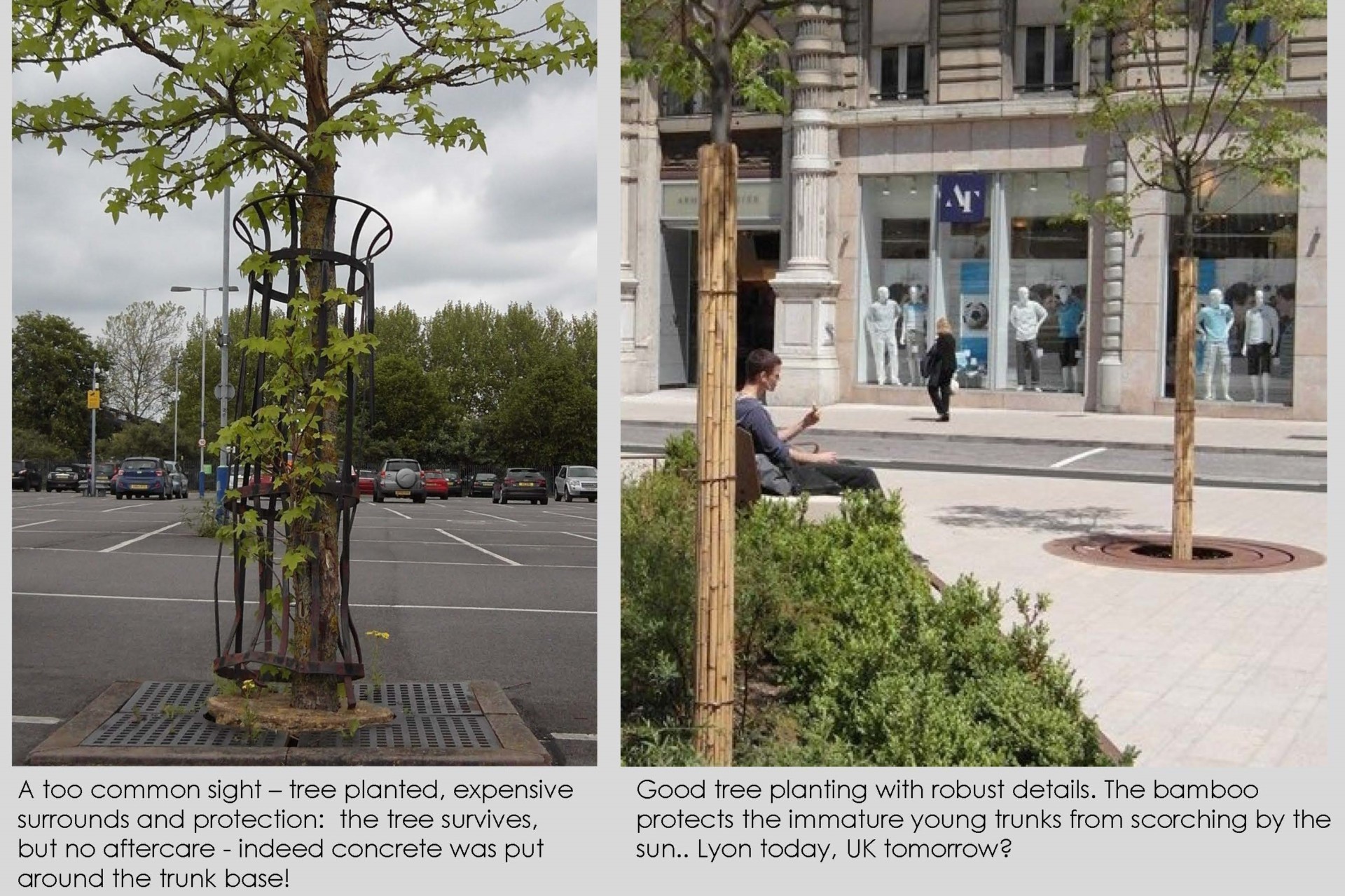
Observation would indicate that planting success has not improved since the report was published. I can offer many examples of where tree planting, carried out with the best of intentions, has failed to deliver ‘independence in the landscape’ and consequently the public goods and benefits associated with trees have been lost.
The ‘Big Tree Plant’[3] was a government sponsored campaign in England in 2010 to promote the planting of one million trees in neighbourhoods where people live, work and play. Tree planting was financed through government grants with proposals for grant funding submitted by public authorities, NGO’s and community groups. The scheme was considered a success and the numbers to be planted were achieved.
The Boris Johnson administration at the Greater London Authority sponsored the planting of 10,000 urban trees during each of his two terms of office. Again, planting was financed by grant with public authorities bidding for funding and again the numerical targets were achieved. Many other central and local government planting initiatives have been completed in addition to the numerous initiatives led by NGO’s and others. All have been well intentioned but none, to my knowledge, have been subjected to long term audits to establish whether the initiatives have delivered the benefits and public goods intended.
Currently, there are many planting initiatives in the public domain either being implemented or planned. For example, the government made a commitment to plant an additional 100,000 new urban trees over a two-year period starting with the 2021 planting season through the Urban Tree Challenge Fund[4], there is the ambition that all streets on new development should be tree lined, and there is the proposed Urban Forest Environmental Land Management (ELMS)[5] where tree planting initiatives are to be evaluated according to the delivery of one or more of six public goods, although the future of this approach for both rural and urban land management appears to be in some doubt.
It is here that the ‘performance gap’ becomes pertinent. As stated above, planting by numbers and or percentages can have a value, but only if the benefits and public goods are achieved in the long term. This means trees must survive and grow. ‘Establishment’ must mean more than the planted tree coming into leaf for two or three seasons before succumbing to environmental pressures and gradually fading away before that ‘independence in the landscape’ is achieved.
I have lost count of the number of sites I have visited in recent years where newly planted trees are struggling or have failed. These sites include street tree plantings, parkland planting, community planting, plantings on new housing developments and many more.
So why is this the case?
The lack of an adequate audit has already been discussed, but this is not true of many local authorities who keep detailed records of planting and young tree development post planting.
The information in the public domain about tree planting and management is extensive and certainly beyond the scope of this article to outline in full.
The number of research papers from the UK and beyond is staggering and almost beyond reading because of the volume involved. The two Trees and Design Action Group (TDAG) documents Trees in the Townscape[6], and Trees in the Hard Landscapes: A Guide for Delivery[7] offer extensive guidance as to best practice coupled with numerous case studies. BS 8545 Trees from Nursery to Independence in the Landscape, referred to above, offers stage by stage advice.
The TDAG Guide to Tree Species Selection for Green Infrastructure: A Guide for Specifiers[8] written by Dr Andrew Hirons and Dr Henrik Sjoman is arguably the best of its kind offering detailed information about individual tree species and their suitability for planting in the urban environment.
There have, in recent years, supported by the Arboricultural Association, The London Tree Officers Association, Barcham Trees and many others, been many presentations at conferences and seminars in the UK from world renown researchers such as Dr Ed Gilman and Dr Gary Watson whose book, The Practical Science of Planting Trees (2013)[9] remains one of the most comprehensive sources of information available. The above references are just the tip of the iceberg so the reasons for the identified performance gap is not the availability of information and guidance.
During the many discussions had by the drafting panel of BS 8545 Tony Kirkham, former Head of the Kew Arboretum, commented, ‘It is really easy to photograph badly planted trees but really difficult to photograph well planted and thriving young trees.’
I would suggest that wherever you are reading this article you will not have to walk more than 1000 metres to find examples of young trees poorly planted or poorly maintained that have absolutely no chance of delivering longevity, benefits, or public goods into the future. Please accept the challenge.
Discussions of the performance gap at recent TDAG meetings outlined the following:
Afterword
TDAG is proposing to prepare a set of small guidance documents on how to close the performance gap and will be running 6 online seminars in 2023 with guidance for successful urban tree planting.
All TDAG guidance documents are free to download from the TDAG website and notice of TDAG seminars and events is also available there – www.tdag.org.uk
References:
[1] https://knowledge.bsigroup.com/products/trees-from-nursery-to-independence-in-the-landscape-recommendations/standard
[2] https://www.researchgate.net/publication/262857090_Trees_in_Towns_II_A_new_survey_of_urban_trees_in_England_and_their_condition_and_management
[3] https://www.gov.uk/government/news/the-big-tree-plant-new-partnership-to-plant-one-million-trees
[4] https://www.gov.uk/guidance/urban-tree-challenge-fund
[5] https://www.gov.uk/government/publications/environmental-land-management-schemes-overview
[6] https://www.tdag.org.uk/trees-in-hard-landscapes.html
[7] https://www.tdag.org.uk/trees-in-hard-landscapes.html
[8] https://www.tdag.org.uk/tree-species-selection-for-green-infrastructure.html
[9] https://blackwells.co.uk/bookshop/product/The-Practical-Science-of-Planting-Trees-by-Gary-W-Watson-E-B-Himelick/9781881956730

Opinion Piece The SEA – Creating homes and buildings fit for the future The Sustainable Energy Association (SEA) is a 21-year-old member-based trade association, committed
Industry news RICS artificial intelligence in construction report A RICS report, based on surveys of over 2,200 professionals, finds AI adoption in construction remains low
Industry news Call for workforce reforms to tackle construction skills crisis A CSJ report warns the construction sector will miss the 1.5 million homes target
