The Future is Live Data
Opinion Piece The Future is Live Data The UK is urgently addressing health and climate issues with its housing stock with the imminent Warm Homes


A new sector-wide study reveals overwhelming support for clearer sustainability standards in the UK’s built environment – with 86% of professionals calling for mandatory Lifecycle Assessments (LCAs) on products to cut through confusion and rebuild trust.
The figure, published in the ‘Greenhushing: Silence is Costing Credibility’ report, highlights growing momentum for practical, measurable tools to support credible sustainability communication. Developed by Futurebuild, The Anti-Greenwash Charter, The Carbon Literacy Project and communications specialist, Hattrick, the findings from the first annual Green Claims Pulse Survey offer a detailed picture of where the industry stands – and where it wants to go.
Alongside a demand for standardisation, the report, calling on over 3,000 professional and public voices (2,820 consumers and 277 respondents working within the built environment) shows that younger generations are ready to engage and expect businesses to lead. Two-thirds of 24–35 year olds believe the sector can build a greener future, compared to only 18% of over-45s. What’s more, 41% say they want businesses to lead and want to see evidence, not spin.

“This is a turning point,” says Martin Hurn, Event Director at Futurebuild. “We’re seeing a groundswell of optimism from younger people and a clear appetite across the industry for better tools, better training and more transparent communication.”
The report warns that if organisations fail to talk about their progress, they risk losing relevance with future talent. Among industry leaders, a lack of transparency is also shown to be eroding trust and undermining industry partnerships. 52% have already switched or considered switching suppliers due to unclear claims.
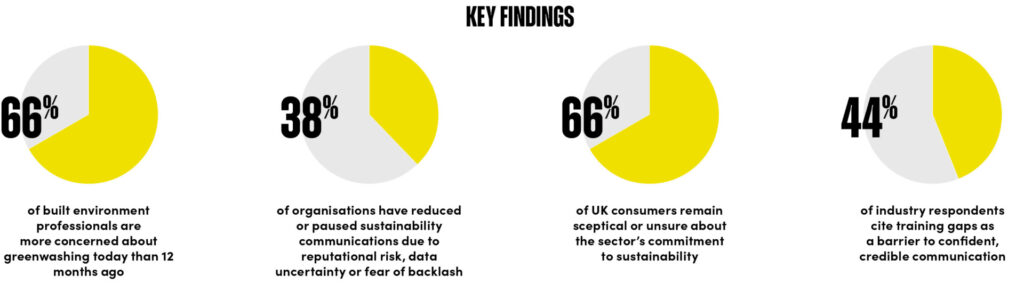
Two-thirds of professionals have also become more concerned about greenwashing than they were 12 months ago, and 38% admit to dialling down public messaging on green progress for fear of backlash, reputational risk or data uncertainty, showing that many organisations are stuck between ambition and anxiety.
“It’s not about having perfect answers. It’s about sharing the journey with integrity,” says Malin Cunningham, Hattrick’s founder and certified Carbon Literacy Trainer. “When businesses explain what’s hard, what’s changing and what’s next – people listen. And when teams understand the issues, the terminology and that no business has got this all figured out yet, they feel more confident in sharing where they are at. That makes for authentic, powerful stories that stand up to scrutiny.”
The research finds that just 18% of professionals feel “very confident” spotting greenwashing and nearly half (44%) say that training gaps are stopping them from speaking up.
Interestingly, when exploring what makes teams more confident in communicating their sustainability journey, the same themes come up. They attributed this to deeper knowledge, better data and third-party certification.
There was also a clear call for standardisation. Not just of the language and terminology, but also of how we benchmark the relevant environmental benefits of products. This is evident from the strong support for LCAs, which was one of the proposals put forward by the Government as part of the recent Construction Products Reform Green Paper 2025.
“We see a real desire across construction firms and supply chains to be responsible communicators, and the fear of reputational and legal backlash from getting it wrong is palpable,” says Charlie Martin, CEO & founder of The Anti-Greenwash Charter. “Standardisation can help fix this by providing the structure, support and accountability needed to protect trust and accelerate progress.”
For the full research findings, download the newly published ‘Greenhushing: Silence is Costing Credibility’ report here.
-ENDS-
Notes to Editor:
About Futurebuild
Futurebuild’s ongoing collaboration with The Anti-Greenwash Charter and involvement with this research initiative reflects the event organiser’s commitment to supporting industry change in a constructive and collaborative way.
The lead theme for Futurebuild 2026 – Connect – is all about strengthening relationships across the industry, connecting specifiers with the supply chain, ideas with action and people with opportunities to drive progress.
Indeed, building a better future for the built environment where safety and sustainability are a dual focus.
Futurebuild’s key findings:
About The Anti-Greenwash Charter
The Anti-Greenwash Charter was created to break the cycle of fear and inaction. We provide organisations with the structure, support and accountability they need to communicate credibly and confidently.
Through our structured process – including green claims policy development, awareness training and transparent campaign reviews – we help signatories move beyond vague intentions or silence.
The Charter empowers teams to raise standards across their supply chain, reduce legal & reputational risk and meet growing demands for clarity, evidence and authenticity in sustainability communications.
The Anti-Greenwash Charter’s key findings:
About The Carbon Literacy Project
The Carbon Literacy Project is a UN-recognised training accreditation body with global reach. The charity provides a comprehensive framework to help organisations create and deliver peer-to-peer training.
From SMEs to multinationals, the project enables teams to understand the science, language and practical implications of climate action. The training builds not just knowledge, but conviction to help people feel confident in their ability to take action and communicate what matters most.
The Carbon Literacy Project’s key findings:
About Hattrick
At Hattrick, we help organisations build commercial credibility and a competitive edge with PR, Thought Leadership and Carbon Literacy training.
Our approach is rooted in integrity – converting the complex into clear, compelling storytelling.
We developed the first accredited Net Zero Masterclass for sales & marketing teams in the built environment and work with organisations to educate staff, supply chain and customers.
Proudly a certified B Corp and Carbon Literate team.
Hattrick’s key findings:
For media enquiries:
Contact rachael.crowe@wearehattrick.com
+44(0) 7495 962647
-ENDS-
